Help lower your tax liability in retirement with these 10 key actions.
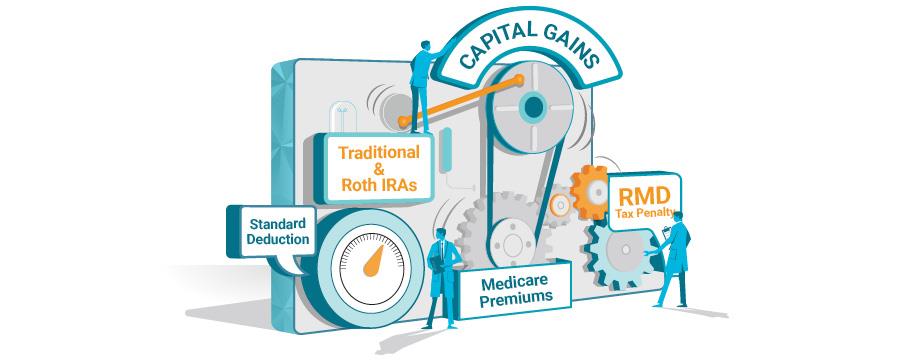
Managing the impact of taxes in retirement is challenging. Navigating IRS rules and understanding the tax implications of withdrawals from retirement accounts can be complex. Further, if not planned for, taxes can diminish your hard-earned savings, leaving you with less room to adjust your spending later in retirement.
We can work with your tax professional to help identify tax strategies that can help your retirement income last longer. Here are the top strategies that can potentially reduce your taxes in retirement.
1. Create a tax-efficient income strategy
Your retirement income may come from a variety of sources, including 401(k) plans, IRAs, pensions, annuities, deferred compensation and Social Security. Each of these income streams will be taxed differently, and strategically timing your income withdrawals can potentially help you pay less in taxes throughout your overall retirement.
For example, it may be advantageous to take distributions from tax-deferred retirement accounts such as a traditional 401(k) or IRA before you are required to, if you’re in a lower tax bracket. In other circumstances, you may take advantage of lower rates available by taking distributions from non-qualified accounts and realizing long-term capital gains.
Advice spotlight
Withdrawals from Roth accounts can be beneficial when your tax rate is higher.
When certain conditions are met, distributions from Roth accounts are tax-free, meaning they won’t count toward your taxable income for the year.
2. Know how your taxable income affects your Medicare costs
If your modified adjusted gross income (MAGI) exceeds certain thresholds, you’re required to pay a surcharge on top of the standard premium for Original Medicare. The surcharge, known as the Income Related Monthly Adjustment Amount (IRMAA), can significantly increase the amount you’re required to pay for your monthly premiums and prescription drug plans. Deductibles and copays may also apply depending on the plan you select.
3. Plan for the potential impact of RMDs
Once you turn 73 (increasing to 75 in 2033), you are mandated by law to take required minimum distributions (RMDs) from tax-deferred retirement accounts such as a traditional IRA or 401(k). It’s not uncommon for these required withdrawals to push retirees into a higher income tax bracket since RMDs are considered part of your taxable income.
An increase in taxable income could lead to a higher tax bill and potentially affect the taxes you pay on your Social Security benefits, and trigger the Medicare surcharge and the net investment income tax. Proactively planning for RMDs as part of your retirement income strategy can help mitigate the impact of taxes on your retirement assets.
4. Be aware of the retirement “tax torpedo”
Once you start receiving Social Security and RMDs, that income can sometimes push you into a higher tax bracket, resulting in an unexpected jump in taxes that’s often referred to as the retirement “tax torpedo.” You can avoid this scenario by proactively planning for the increase in income and being strategic about when you start Social Security benefits.
5. Take advantage of your early retirement window
It’s common for retirees to have a lower taxable income in the years prior to collecting Social Security and required minimum distributions. Known as the “early retirement window,” this period provides you with an opportunity to employ tax strategies that can extend your retirement dollars further while also providing flexibility in the future.
For example, during this time, a Roth conversion can be advantageous. You’ll have to pay taxes on the pretax contributions and earnings you convert, but once the money is in the Roth IRA, you won’t owe any taxes on it again. This means any withdrawals won’t count toward your taxable income, reducing the chances of unexpectedly getting hit with the Social Security tax torpedo or Medicare surcharges.
6. Consider a QCD
If you’re 70½ or older, you can directly transfer money from a traditional IRA, tax-free, to a qualified charity each year. Known as a qualified charitable distribution (QCD), this gift (which is subject to annual limits) can count toward your RMD without being added to your adjusted gross income, and you won’t have to itemize deductions to take advantage of it. Keeping your RMD out of your adjusted gross income can also help avoid Medicare surcharges and lower the portion of your Social Security benefits subject to taxes.
7. Harvest your losses
If you have experienced any investing losses, they can potentially become a tax-savings opportunity through a strategy called tax-loss harvesting. When executed properly, tax-loss harvesting allows you to manage and reduce your tax burden by selling investments at a loss to offset the taxes owed on capital gains from other investments.
8. Use your HSA to pay for medical expenses
If you saved in a health savings account (HSA) in the years leading up to retirement, consider the benefits of using it to pay for your health care expenses or long-term care needs. Medical expenses in retirement can be significant, and HSA withdrawals won’t count toward your taxable income.
9. Prepare for the unexpected
One often overlooked effect of a spouse’s passing is the impact it can have on the surviving partner’s taxes. After a married person passes away, the surviving spouse’s filing status will change to that of a single filer, but their expenses typically don’t get cut in half, which often triggers a range of tax consequences — including the taxes they pay on their Social Security benefits, how much they will be charged for Medicare premiums and more.
10. Regularly review your tax situation
Many of the most common retirement milestones have potential tax consequences. Deciding when to take Social Security, moving to another state, working in retirement, paying for health care or the death of a spouse can all affect your income and your taxes, sometimes in unexpected and significant ways. To help navigate these changes, review your financial planning and tax strategies regularly with a financial advisor in coordination with a tax professional.
Plan today to secure your tomorrow
We can work with you and your tax professional to find tax-smart strategies that can help extend your retirement dollars further.