Get answers to common questions about annuities, how they work and what type of annuity may be right for you.
Do you have enough savings to last throughout your retirement? It’s a common question — and concern — especially during periods of uncertainty. If you’re looking for a dependable income stream, annuities can be an important part of your retirement income strategy.
We can help you decide if an annuity makes sense for you, your retirement needs and your overall financial goals. Here are answers to some of the most common questions about annuities and how they work:
In this article:
- What is an annuity?
- What are the different types of annuities?
- How do deferred annuities work?
- How do annuities pay out income?
- When should I purchase an annuity?
- How do I determine what type of annuity is right for me?
- What else should I consider before purchasing an annuity?
- Are annuities taxable?
- Questions to discuss with us
What is an annuity?
An annuity is a long-term retirement investment product issued by an insurance company. It’s a common retirement tool because it can offer the following benefits to investors:
- Guaranteed income: Annuities can provide regular, guaranteed income for the rest of your life, for a set period, or provide a bridge to Social Security if you choose to retire early.
- Tax advantages: The money inside an annuity generally grows tax-deferred, meaning that any gains on the amount of premium invested won’t be taxed until the money is withdrawn.
- Protection from market volatility: Some annuity contracts offer guaranteed rates of return. While your rate of return on these annuities can be higher than the minimum, it will never go below the guaranteed rate, offering some protection from market volatility.
- Estate planning advantages: Most annuities offer a death benefit that will protect your original investment for your beneficiaries. Additionally, annuity contracts offer several options for survivor benefits.
What are the different types of annuities?
Though there are now a large variety of annuities available, most fall into one of two broad categories: immediate and deferred:
Immediate annuities
Immediate annuities are typically purchased with a single lump sum and generally start paying out a regular income stream within a year of purchase. You can choose from a variety of income options with immediate annuities, including some that provide income for your spouse or beneficiaries if you die prematurely.
Deferred annuities
Deferred annuities are typically designed to let you accumulate tax-deferred savings with the option to annuitize — converting all or part of the annuity into an income stream — for either a specific period or for as long as you live in retirement. There are several different types of deferred annuities, the most common of which include:
- Fixed annuities offer a fixed rate of return guaranteed to never fall below a certain minimum rate.
- Variable annuities offer growth potential from a choice of underlying investment options. They also provide a guaranteed death benefit for your beneficiaries.
- Structured annuities provide opportunities for growth and a level of protection that can help manage some of the risk that comes with investing.
- Fixed index annuities provide opportunities for growth based on the performance of certain market indexes while protecting your principal from losses.
How do deferred annuities work?
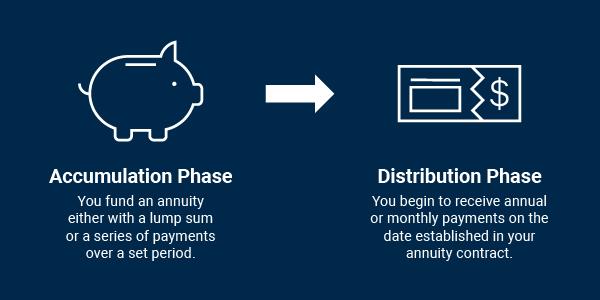
With a deferred annuity, you pay the annuity company premiums over a specified period (or in one lump sum). Then, in the future, the annuity company starts paying you. In general, annuities work through two different stages:
- Accumulation phase: During this period, you pay premiums into the annuity. Depending on the type of annuity, you can choose to pay over a specified period, with one lump sum or with add-on payments.
- Distribution phase: During this period — depending on the terms of the annuity contract — you receive monthly, quarterly or annual payments.
Variable annuity calculator
Use this calculator to see how a variable annuity could fit with your retirement income strategy.
Run the numbersHow do annuities pay out income?
Different types of annuities have different payout options:
Joint-life payout: You will receive a lifetime payout for yourself and one other person, typically a spouse. Because a joint-life payout is likely to provide benefits for a longer period, the payout is typically lower than for annuities with a single-life payout.
Life-with-period-certain payout: You will receive payments for the rest of your life, but if you pass away during a specified period, your beneficiary will receive payments only for the duration of that period.
Debunking common annuity myths
Clear up common misunderstandings about annuities and learn how they can be used to help you reach your financial goals.
Learn moreWhen should I purchase an annuity?
Because there are so many options with annuities, buying an annuity will depend on a host of factors, including your age, life expectancy, needs and financial goals. Immediate annuities tend to make more sense for those who have already retired or are close to doing so because they typically pay out right away.
Deferred annuities may make sense if you have a longer time horizon (as your premiums will have more time to benefit from tax-deferred growth) and if you have already maxed out contributions to tax-advantaged retirement accounts like an IRA or 401(k).
How do I determine what type of annuity is right for me?
Given the variety of annuities available, talk to my team to determine which type of annuity may help you reach your financial goals. Among other things, you will want to consider:
Payout options: Do you want an annuity that guarantees payments for the rest of your life, one that pays out for a predetermined amount of time, such as 5 or 30 years, or some combination?
What else should I consider before purchasing an annuity?
Surrender charges: If you’re considering a deferred annuity, understand the surrender period, which is the time you must wait until you can withdraw funds without facing a penalty. Known as a surrender fee, that penalty is typically a percentage of the withdrawal amount and usually declines over time.
Are annuities taxable?
An annuity’s tax treatment is determined by the specific type of annuity you purchase – either qualified or non-qualified:
Non-qualified annuities are not purchased through a qualified retirement account and therefore are funded with after-tax dollars. With non-qualified annuities, you only pay taxes on the earnings or interest portion of the distribution, but not the principal. However, like a qualified annuity (or any qualified account), non-qualified annuities are also subject to a penalty if withdrawals are taken before age 59½.
Learn more: Annuities and taxes
Is an annuity right for you?
We can help you decide if an annuity makes sense for your situation, your retirement plan and your overall financial goals.