Explore the potential tax advantages of annuities and understand how the IRS treats this retirement investment product.

Annuities can offer steady income and tax benefits, making them a popular way to fund retirement. However, an annuity’s tax benefits will ultimately depend on the type of annuity you choose.
We can help determine what type of annuity can help reach your goals and account for the impact of taxes on your retirement savings and income.
Here’s how annuities are taxed:
How are annuities taxed?
An annuity’s tax treatment is determined by the specific type of annuity you purchase — immediate or deferred — and how the annuity is funded.
How are immediate annuities taxed?
Immediate annuities are purchased with a single lump-sum payment and, in exchange, pay a guaranteed income that starts immediately. How that income is taxed depends on whether the lump sum is funded with pretax or after-tax dollars:
- Pretax funding: If the annuity is purchased with pretax dollars, such as funds from a traditional IRA or 401(k), all payments are taxed as ordinary income.
- After-tax funding: If the annuity is purchased with after-tax dollars, only a portion of each payment is taxable. Each payment you receive is generally a mix of:
- A return of the principal which is not taxed because taxes were already paid on those dollars.
- Earnings, which are taxed as ordinary income.
How are deferred annuities taxed?
Deferred annuities accumulate earnings tax-deferred and are taxed based on whether you purchase a qualified or non-qualified deferred annuity.
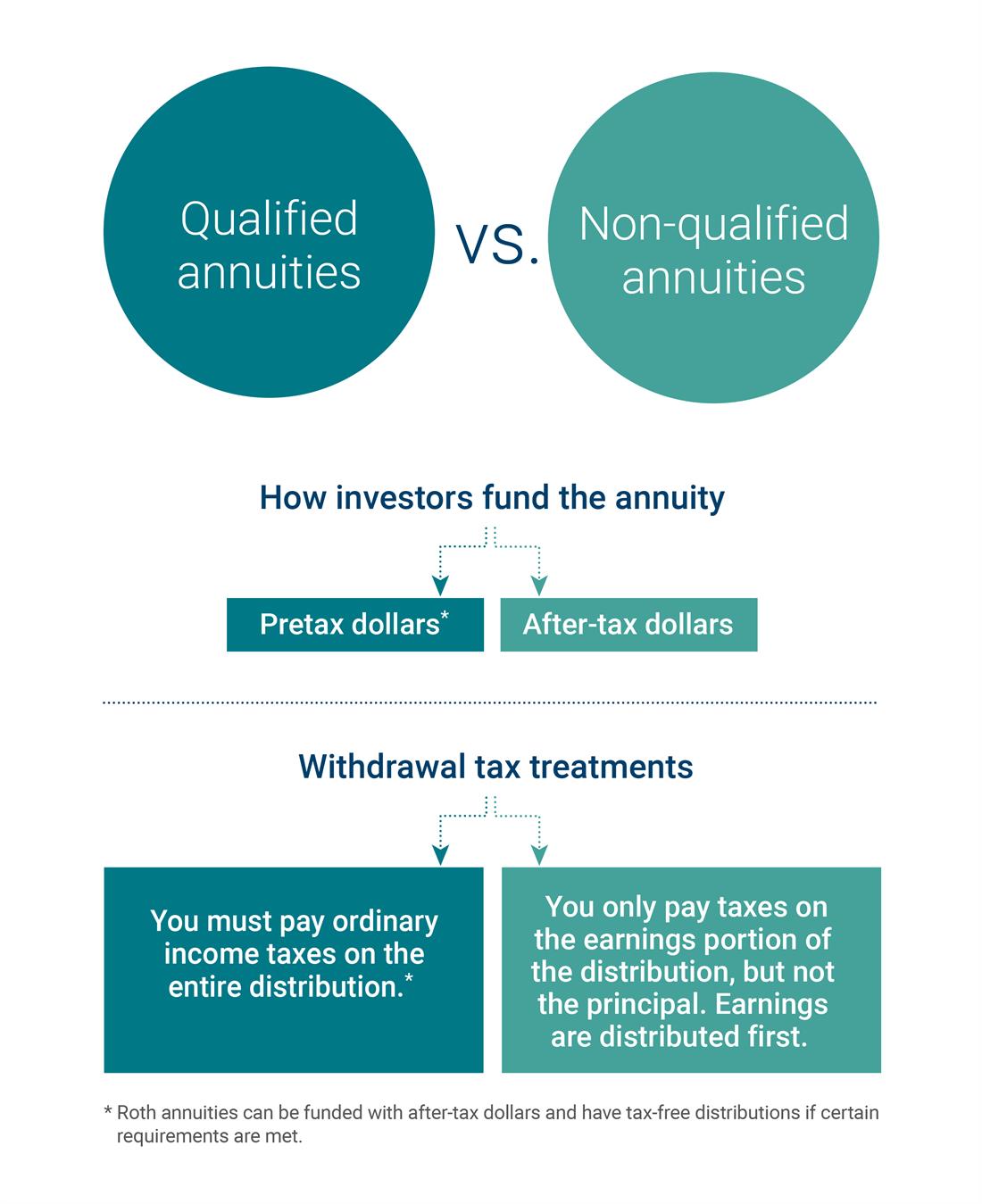
- Qualified deferred annuities are purchased through a qualified retirement account, such as a traditional or Roth IRA, which means your annuity’s distributions are subject to the same tax rules that govern those accounts. Generally, qualified annuities are funded with pretax dollars, though Roth annuities are funded with after-tax money.
- Non-qualified deferred annuities are not purchased through a qualified retirement account. Instead, they are funded with after-tax dollars (i.e., cash). As such, the funding limits and contribution rules that apply to qualified retirement accounts do not apply. With non-qualified annuities, the distributions of earnings are taxed as ordinary income, but you won’t pay taxes on distributions of the premium or principal you initially deposited. However, unlike after-tax immediate annuities, deferred annuities follow an “earnings-first” withdrawal rule. This means any withdrawals are fully taxable as ordinary income until earnings are depleted.
Non-qualified annuities can be especially beneficial if you’ve already maxed out your 401(k) and IRA.
If you’re looking for another tax-advantaged vehicle for your retirement funds, non-qualified deferred annuities can help you continue to save in a tax-deferred manner, while also providing you flexibility on withdrawals.
What are the tax implications of early withdrawals from a deferred annuity?
An annuity can be a smart addition to your retirement income strategy, but know that if you make a withdrawal prior to the designated time period, you may be subject to pay an early withdrawal penalty from the IRS, as well as potential surrender charges from the annuity issuer.1 Generally, annuity withdrawals made before age 59½ are subject to the IRS 10% early withdrawal penalty.
- If you withdraw money early from a pretax qualified annuity: The entire distribution amount may be subject to the penalty.
- If you withdraw money early from a non-qualified annuity: Typically, only withdrawn earnings will be subject to the penalty.
While there aren’t many exceptions to the 10% early withdrawal penalty, you can explore potential options with your tax professional that may be available to you based on your individual circumstances.
Find an annuity that works for you
There are a variety of annuities that can help meet your retirement savings goals, income needs and tax situation. We can evaluate your finances holistically and help determine which type of annuity may be appropriate for you.