AI is creating new opportunities across markets, but from our perspective, the real story is not the technology itself. It’s a multi-year transformation unfolding in distinct waves, each with its own leaders and beneficiaries.
Overall, we see capital flowing through the AI ecosystem in sequence, creating cascading opportunities as adoption deepens. Understanding where we are currently in this cycle, and what may come next, can make it easier to position your portfolio for what lies ahead.
Here are the four waves of AI investment growth and how to identify companies that are poised to benefit at each phase:
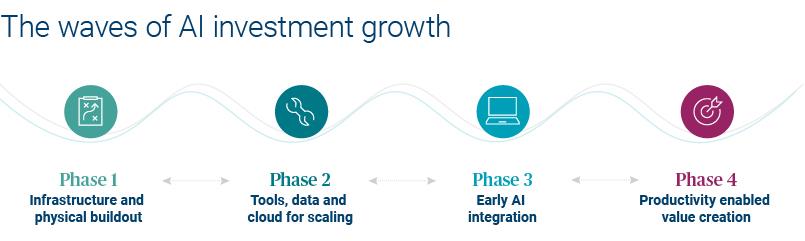
Wave 1: Infrastructure and physical buildout
What is Wave 1? The first wave is the infrastructure phase, the most visible and capital-intensive stage, and it’s where we currently are today. During this stage, companies are investing heavily in the technology, systems and facilities needed to develop and run AI tools. This includes creating advanced AI models and building physical infrastructure, like data centers. These early investments help set the stage for how AI will grow and be used in the years ahead.
Potential investing opportunities: At this stage, opportunities are concentrated in the companies building and supporting the core infrastructure that makes AI possible:
- Hyperscalers: Hyperscalers are the large tech companies that provide the massive computing power and cloud services needed to power AI tools. They alone are on track to invest more than $500 billion in 2026 to expand AI-ready infrastructure.1
- Semiconductors: Companies that design and produce graphics processing units (GPUs) or enable high-speed data movement and network are poised to be major beneficiaries in the first wave.
- Data center power and equipment: Companies that are able to solve the bottlenecks in power and cooling will be well-positioned.
Wave 1 outlook: We see this phase having another two to three years of strong momentum. The physical requirements of AI, the rise of model-as-a-service offerings and the global race to build sovereign AI capacity drive this growth. Core exposure to infrastructure remains relevant, but leadership will evolve as the buildout matures.
Wave 2: Tools, data and cloud platforms for scaling
What is Wave 2? As infrastructure expands, companies move from early experimentation to scale deployment. This transition fuels the second wave where tools, data architecture, cybersecurity and cloud-based AI platforms play a defining role.
Potential investing opportunities:
- Data preparation, storage and analytics: Companies that make data usable, structured, secure and ready for AI are well-positioned to capitalize on this wave.
- Cybersecurity: As enterprises expand their digital footprint, companies that protect sensitive data and AI models may see increased demand.
- Hyperscalers: These firms remain central at this stage because they lower the barriers to adoption. They provide pre-trained models, managed services, guardrail tooling and integrated developer environments that make it easier for organizations to adopt and scale AI.
Wave 2 outlook: We expect this wave to run three to five years as enterprises operationalize AI across business units.
Wave 3: Early enterprise AI integration
What is Wave 3? The third wave is marked by AI integration within enterprise software, and we’re seeing early evidence of this behavior occurring. Unlike infrastructure, which scales quickly once capacity is built, enterprise adoption is methodical. Companies test, validate and pilot before they roll out at scale.
Potential investing opportunities:
- Early leaders in enterprise software: Companies that successfully embed AI into everyday tools (like productivity platforms and cloud-based services) are well-positioned to benefit as they help people work more efficiently and collaborate more effectively.
- Companies that can leverage AI to improve customer outcomes: Early adopters outside of tech that can show clear results from using AI may also stand out as early winners in this phase. This could include better digital experiences, faster customer service or more efficient product development.
Wave 3 outlook: We expect this phase to unfold over three to four years, accelerating as the first wave of adopters begin to demonstrate a measurable return on investment. As with any major technological transition, moments of pullback or shifting expectations are to be expected. The path from AI investment to monetization will take time as companies gather data, build and test models, and determine deployment strategies, while their customers simultaneously vet those offerings for security and utility.
In our view, these pauses are a normal and healthy part of the refinement process, helping enterprises move beyond early experimentation and focus on what delivers real, long-term value.
Wave 4: Productivity-enabled value creation
What is Wave 4? The fourth wave is the most powerful. Here AI becomes an economic force rather than just a technology category. We estimate that AI currently contributes 10 to 20 basis points (bps) of productivity per year. We believe this could expand to 50 to150 bps annually as adoption scales, workflows adapt and companies fully integrate AI into core operations.
Potential investing opportunities: As AI becomes more deeply embedded in how businesses operate, the greatest opportunities shift toward companies that can turn technology into real, measurable results. Companies that can demonstrate the following outcomes may widen their competitive lead:
- Scale beyond early testing: Companies that move effectively from small pilots to enterprise-wide deployment are better positioned to capture the full value of AI.
- Leverage proprietary data: Organizations that can use their own proprietary data to train and enhance AI tools may have a distinct advantage.
- Redesign processes: Businesses that redesign processes, not just layer AI on top of existing ones, are more likely to unlock meaningful efficiencies.
- Demonstrate real productivity gains: Companies that can clearly demonstrate improved productivity, cost savings, or better customer outcomes are likely to stand out.
Wave 4 outlook: The fourth wave has the potential to be the most transformative, but it’s also the most difficult to quantify in the near term. As AI adoption matures, we expect to see wider differences in performance across industries, with some companies pulling ahead as clear leaders while others lag behind based on how effectively they put AI to work.
Why hyperscalers stand out across all waves
Most companies will benefit from one or two waves. However, we see the hyperscalers as unique multi-wave beneficiaries.
They participate in every stage:
- Wave 1: Building infrastructure and gaining internal efficiency.
- Wave 2: Powering AI development through tools, models and cloud platforms.
- Wave 3: Embedding AI into their own software and consumer experiences.
- Wave 4: Capturing long-term cloud consumption as customers’ AI success compounds.
The breadth of their exposure, strong balance sheets and deep customer relationships position them as long-term anchors in AI-driven growth.
The bottom line
AI is a succession of waves rather than a single investment theme. Each wave creates new leadership and opportunities for active investors. At the same time, the path forward will include periods of adjustment as companies refine where AI delivers sustainable value.
In our view, the transformation ahead will be uneven, iterative and multi-year, but the opportunity set is broad and expanding. As these waves unfold, we believe disciplined research, selective positioning and early recognition of leadership transitions will be essential to capturing the full value of this AI-driven cycle.
Put these insights into action
An Ameriprise financial advisor can help you understand what major market shifts — like the rise of AI —may mean for your investment portfolio and help identify potential opportunities that align with your risk tolerance, time horizon and financial goals.