Bishnu Dhar, Senior Analyst – Ameriprise Financial
12/15/2025

For decades, U.S. equities have been the undisputed leaders in global markets. Thanks to their innovation, strong corporate governance and deep liquidity, American companies have consistently delivered higher returns than their international peers. As a result, investors worldwide have flocked to U.S. stocks, making them the cornerstone of global portfolios.
Over the last year, however, the landscape has shifted. Rising tariffs, geopolitical tensions and structural changes in Europe are challenging the status quo. The question now is whether U.S. equity market dominance is sustainable or if investors should overweight their portfolios beyond American shores.
Here are three reasons why investors may want to consider increasing exposure to foreign markets:
1. Valuation advantage
European and emerging market equities trade at meaningful discounts compared to U.S. stocks, as the chart below shows. Because international stocks are currently priced lower than U.S. stocks, investors have a cushion that can help mitigate their exposure to losses. Over time, these lower prices may rise and move closer to the average, giving investors a chance to benefit if the market returns to normal.
However, valuation gaps typically narrow over time as underlying fundamentals evolve. Should U.S. earnings growth decelerate, potentially due to tariffs or interest rates, a globally diversified portfolio may benefit from fiscal stimulus and monetary easing abroad. As a result, the gap in prices between U.S. stocks and international stocks, or valuation discount, might get smaller, thereby enhancing returns from non-U.S. markets.
Bottom line: Stocks in European and emerging markets are currently priced lower than U.S. stocks. This difference in valuation could mean there's an opportunity for international markets to grow over time.
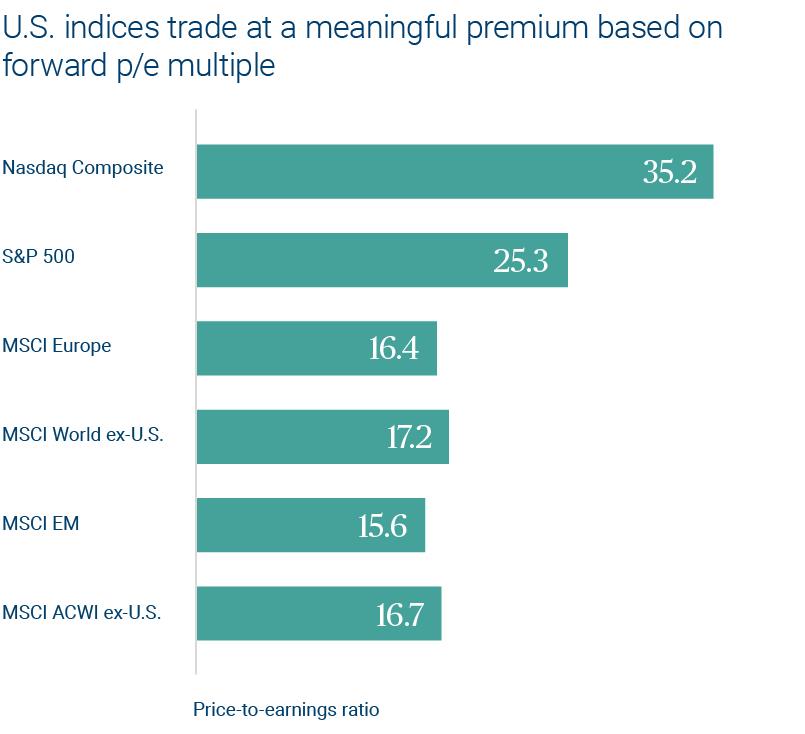
Sources: FactSet and American Enterprise Investment Services, Inc. The forward price-to-earnings multiple is for the next 12 months. Data as of Nov. 14, 2025.
2. Sectoral diversification
International markets offer investors access to sectors that are underrepresented in U.S. equity benchmarks, providing unique diversification benefits and potential growth opportunities.
Geographic and sectoral diversification not only eases the concentration risk in U.S.-centric portfolios, but it also allows investors to tap into growth trends driven by global consumption, sustainability initiatives and technological innovation.
For example:
- Europe dominates the global luxury goods and vehicle industries, commanding significant pricing power and benefiting from steady demand among affluent consumers worldwide.
- Latin America provides exposure to commodities and natural resources, including copper, lithium and agricultural products, which are critical for global supply chains and the energy transition. Companies in Brazil and Chile, for example, are positioned to capitalize on rising demand for battery metals and food exports.
- Asia remains a manufacturing powerhouse, with firms in South Korea, Taiwan and China leading in semiconductors, electronics and industrial automation, sectors essential for technological advancement and infrastructure development.
Bottom line: Participating in international markets can help investors capture opportunities in industries that complement U.S. strengths, enhance portfolio resilience and potentially deliver better risk-adjusted returns over the long term.
3. Currency hedging and historical downturn cushion
Historically, periods of dollar depreciation have coincided with stronger returns for non-U.S. equities, especially emerging market equities. During U.S. market downturns, international equities have often served as a buffer against portfolio volatility.
As illustrated in the below chart, a weaker U.S. dollar often correlates with stronger performance in non-U.S. stocks, as dollar depreciation increases the value of foreign assets in dollar terms and bolsters global trade competitiveness. Emerging markets often benefit as commodity prices rise and debt burdens ease in dollar terms, while developed markets (ex-U.S.) gain from improved export margins.
Additionally, historically, dollar weakness has coincided with global liquidity cycles, encouraging capital flows into regions with higher growth. This dynamic creates a favorable backdrop for international equities, offering both potential valuation upside and diversification benefits for investors seeking opportunities beyond U.S. markets. Accordingly, if the trend of dollar weakness continues into 2026, historical patterns suggest that global ex-U.S. equities may continue to see tailwinds.
Bottom line: U.S. market downturns typically coincide with a weaker U.S. dollar, which in turn tends to benefit international equities. By investing in foreign stocks, especially those in emerging markets, you may help insulate your portfolio from market volatility.
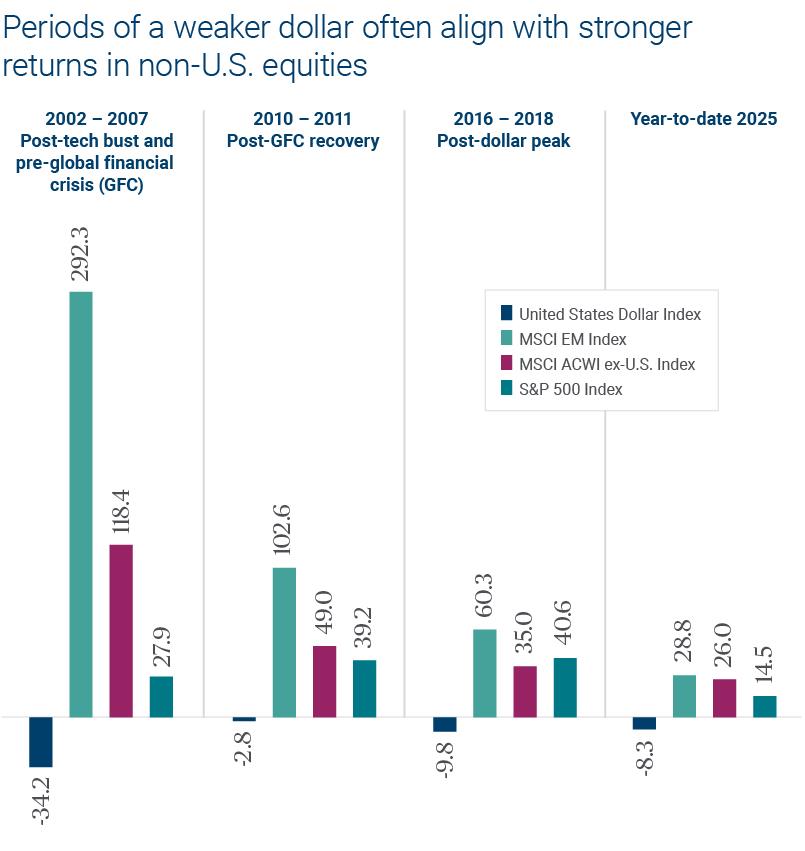
Source FactSet/American Enterprise Investment Services, Inc. For illustrative purpose, cumulative returns are presented for price return indices. An index is a statistical composite that is not managed. It is not possible to invest directly in an index. Past performance is not a guarantee of future results.
Why should investors consider international stocks?
For many years, U.S. equities have outperformed their international counterparts; however, recent changes in market structures and valuation differences suggest their leading role may be under pressure.
New tariffs, changes in supply chains and Europe’s shift toward renewable energy and bolder policy reforms, as well as improvements in corporate governance in Japan and South Korea, along with the rapid growth of India's young population, are among the factors that make a strong case for global investing. In our view, although U.S. markets remain important, investors may benefit from diversifying internationally to find new opportunities and manage risks.
Bottom line: As the domestic and global landscape continues to evolve, investors may want to consider a balanced investment approach that combines the stability of U.S. assets with the growth potential of international holdings. This can help mitigate the portfolio risks associated with overexposure to the U.S. market while also allowing you to capitalize on global growth opportunities.
How can international stocks fit into your portfolio?
If you’d like to better understand the role that international stocks can play in your portfolio, reach out to your Ameriprise financial advisor. They can help you understand your current exposure to foreign equities and make recommendations on incorporating additional international investing opportunities that align with your risk tolerance, time horizon and financial goals.