The strength of the U.S. dollar plays a key role in shaping investment outcomes. Its movement influences the availability of capital worldwide, drives cross-border investment flows and shapes relative asset performance.
For investors, these shifts matter: A stronger dollar can tighten global financial conditions, pressure emerging markets and weigh on U.S. multinational companies. A weaker dollar, on the other hand, can ease financial conditions and support returns for non-U.S. assets.
Understanding what drives these cycles, and how they impact asset prices, can help you navigate global markets effectively. Here are five common dollar patterns that investors should know about:
Trend #1: Major macro events drive the dollar’s direction
The dollar’s journey over the past five decades has been marked by dramatic turning points when monetary policy shifts, global crises emerge or coordinated interventions reshape the currency’s role in world markets. Major shifts in the dollar’s trajectory have historically coincided with changes in global liquidity and risk appetite.
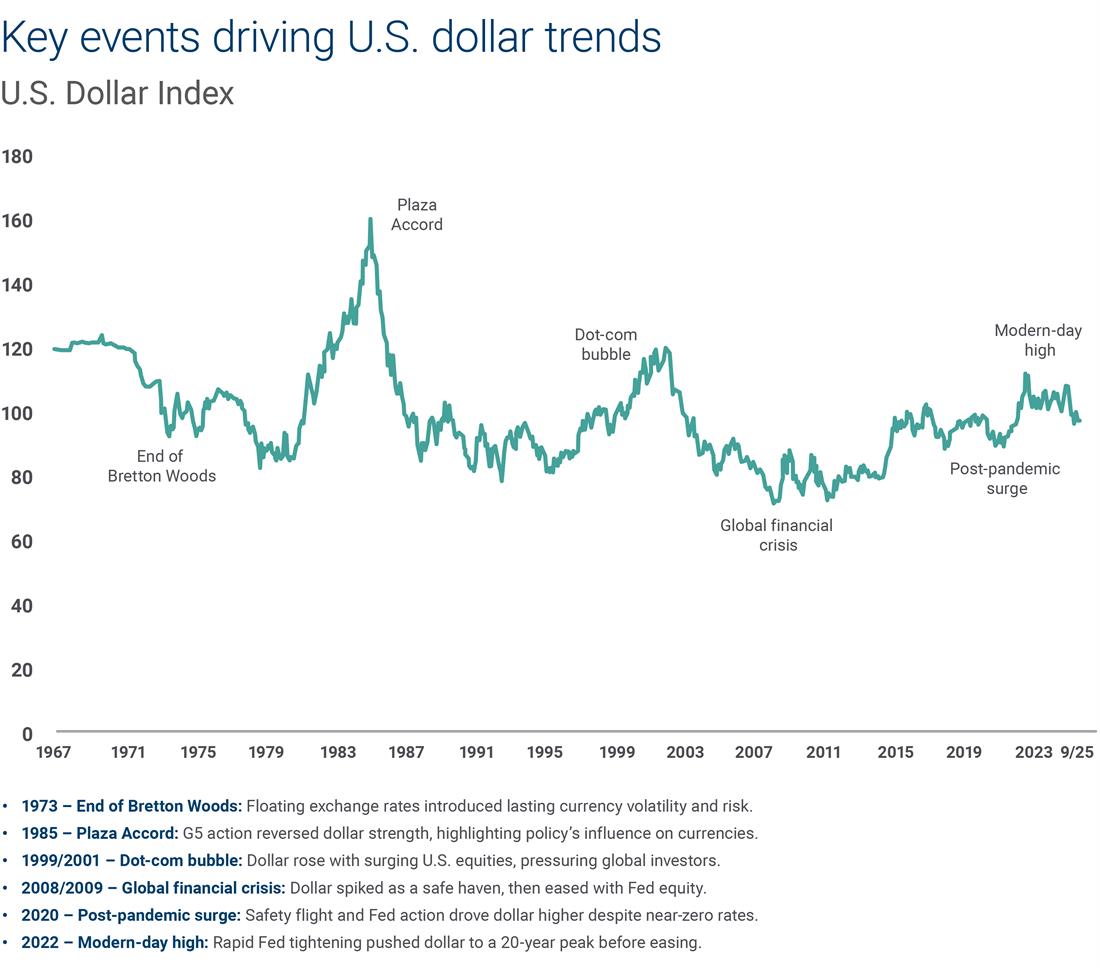
Chart data: 1/31/67-9/30/25. Past performance does not guarantee future results. Indices are unmanaged and not available for direct investment. The U.S. Dollar Index measures the relative value of the U.S. dollar against a basket of other foreign currencies. For illustrative purposes only. Data sources: Bloomberg and Hartford Funds.
Trend #2: Uncertainty can fuel the dollar’s strength
One reason the dollar’s moves have such wide-reaching effects is the currency’s unique role as a global safe haven during times of uncertainty. During periods of market stress, investors often turn to the dollar thanks to the size and stability of the U.S. economy, the liquidity of U.S. financial markets and its role as the world’s primary reserve currency. Dollar-denominated assets can appeal to global investors for their reliability and accessibility, which can drive the currency higher.
Importantly, the safe-haven effect can vary depending on the nature of the crisis and the global backdrop. For example, during the 2008 Global Financial Crisis, which originated in the U.S., the dollar initially surged but later moderated as policy responses unfolded. When uncertainty is concentrated outside the U.S., the dollar’s appeal as a refuge tends to be even stronger.
Trend #3: U.S. stocks tend to navigate dollar movements well
Domestic equities tend to be well-equipped to handle fluctuations in the dollar’s value:
- When the dollar strengthens: U.S. stocks continue to post modest gains, reflecting their relative resilience. Many U.S. companies generate a significant share of revenue domestically, which limits the impact of currency translation. However, U.S. large-cap stocks, particularly multinationals in the S&P 500 Index with substantial overseas sales, can face earnings headwinds as foreign revenues convert into fewer dollars.
- When the dollar weakens: These headwinds ease, and U.S. equities often see a modest performance boost.
Trend #4: Global stocks and commodities are sensitive to dollar swings
The dollar’s impact is most pronounced in international equities:
- When the dollar strengthens: International markets and emerging markets come under pressure as dollar strength tightens liquidity and increases the cost of dollar-denominated debt.
- When the dollar weakens: These markets typically benefit. A weaker dollar improves local currency returns when translated back into dollars and signals looser global financial conditions, which often coincides with stronger growth outside the U.S.
Commodities tend to follow a similar pattern:
- When the dollar strengthens: Most commodities become more expensive for international buyers because commodities are generally priced in the U.S. dollar. This can lead to lower prices globally due to reduced demand.
- When the dollar weakens: Commodity prices typically benefit, as both demand and affordability increase for international buyers.
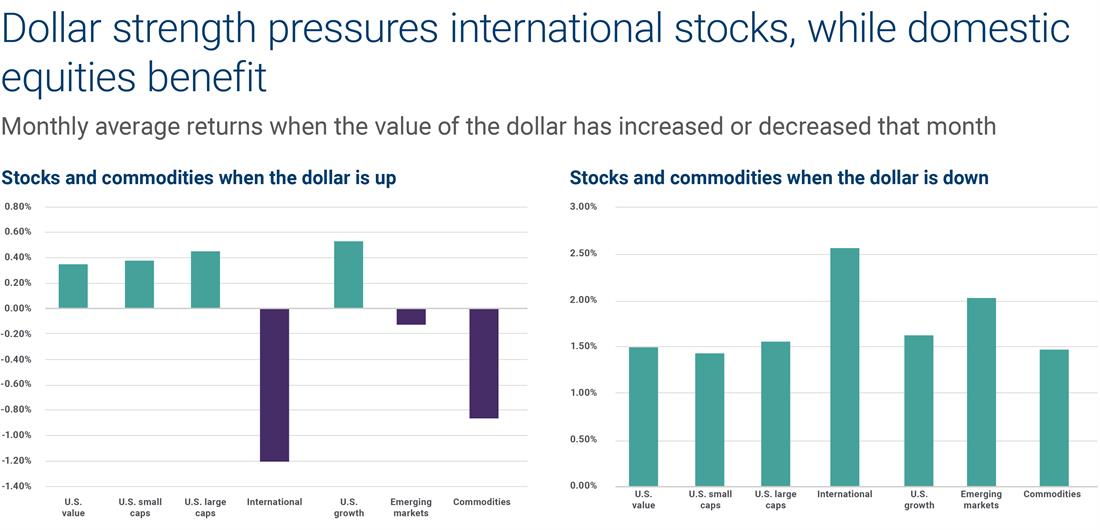
Chart data: 10/31/85-9/30/25. All performance data dates back to 10/31/85 unless otherwise specified in the representative index definitions below. Past performance does not guarantee future results. Indices are unmanaged and not available for direct investment. For illustrative purposes only. Data sources: Morningstar and Hartford Funds.
Trend #5: Bond returns receive a boost when the dollar weakens
Generally, fixed income returns tend to rise when the value of the dollar declines. However, the impact varies by bond type:
- Government bonds: U.S. Treasuries broadly tend to show relatively stable performance regardless of dollar direction, reflecting their domestic focus and lower currency risk.
- High-yield bonds: This fixed income sector historically posts stronger returns compared to other bond sectors when the dollar is rising, likely due to their higher income and risk profile.
- Credit-sensitive bonds: When the dollar weakens, returns for credit-sensitive sectors such as corporates and high-yield bonds generally improve even further, supported by increased global liquidity and risk appetite.
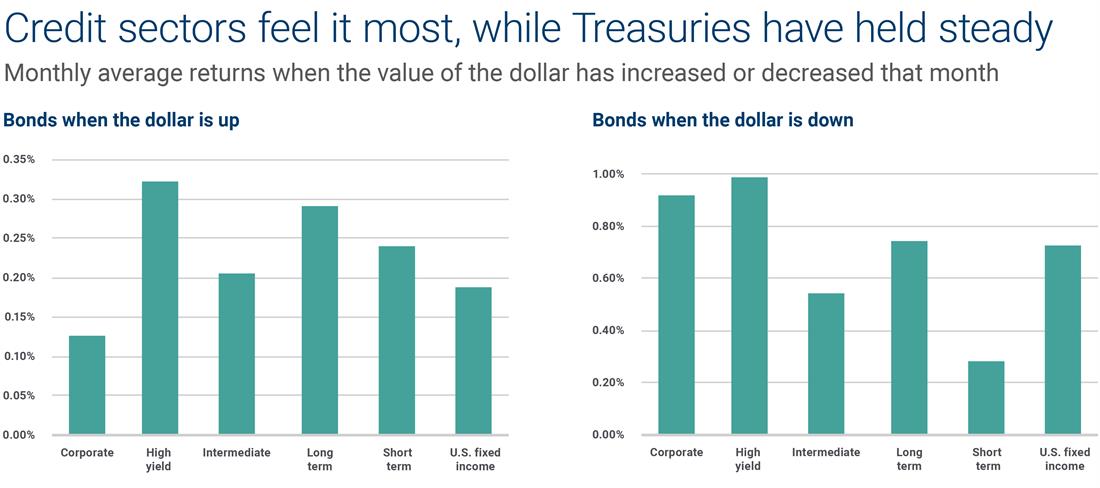
Chart data: 10/31/85-9/30/25. All performance data dates back to 10/31/85 unless otherwise specified in the representative index definitions below. Past performance does not guarantee future results. Indices are unmanaged and not available for direct investment. For illustrative purposes only. Data sources: Morningstar and Hartford Funds.
Bottom line
The U.S. dollar’s value remains an important signal for investors to watch as it often mirrors changes in monetary policy, economic strength and the ease with which capital moves across borders.
Over the years, some clear patterns have emerged: When the dollar strengthens, international stocks, emerging markets and commodities have often struggled, while periods of a weaker dollar have generally supported global returns and created a more positive market backdrop.
These patterns aren’t guaranteed, but understanding how different investments respond to dollar movements can help investors make sense of market shifts and better anticipate potential risks and opportunities.
How do dollar dynamics affect your portfolio?
To better understand how the value of the U.S. dollar may impact your portfolio, please connect with your Ameriprise financial advisor.