Ibrahim Kanan, Managing Director and Head of U.S. Core Equity – BlackRock Fundamental Equities
Over the past few years, the U.S. stock market has been powered by just a handful of companies. Specifically, enthusiasm around artificial intelligence (AI) has supercharged the so-called “Magnificent 7” group — Nvidia, Apple, Amazon, Meta, Alphabet, Tesla and Microsoft — to outsized gains.
However, change may be afoot. After several years of historic concentration in the S&P 500 Index, a long-anticipated broadening may finally start to take shape. Looking ahead, analyst estimates point to a narrowing earnings growth gap between the Mag 7 and the rest of the market in 2026.
This shift may offer investors a chance to buy into fundamentally strong, yet underappreciated, companies at an attractive price. Here are three stock selection strategies to consider as the market landscape evolves:
Strategy 1: Broaden your lens, but narrow your picks
The 10 largest stocks by market cap still represent close to 40% of the S&P 500 Index today. This compares to 19% at the end of 2010.1 In our view, this means many large U.S. companies that are “great, quality businesses” have been overlooked — and that many investors are left underexposed to them by virtue of tracking the index.
Some investors have looked to other indexes for “diversification” away from the S&P 500’s top-heavy bias, such as the equal-weighted S&P 500 and the small-cap Russell 2000 Index. However, we caution that leaning into the former means neutralizing AI outperformance, while pivoting to the latter comes with a quality sacrifice, as many small public companies today are unprofitable. Further, the equal-weighted S&P 500 Index, which apportions each of the 500 constituents at equal measure, has underperformed its market-cap-weighted counterpart amid the recent broadening.
Investing perspective: Investors may want to widen their lens beyond last year’s winners and sharpen their focus on the next leg of potential leaders. This might include narrowing in on a smaller group of names with prospects of delivering more return than the broader U.S. indexes. One potential area of interest: industrials, particularly those that are facilitating and feeding into the AI data center buildout.
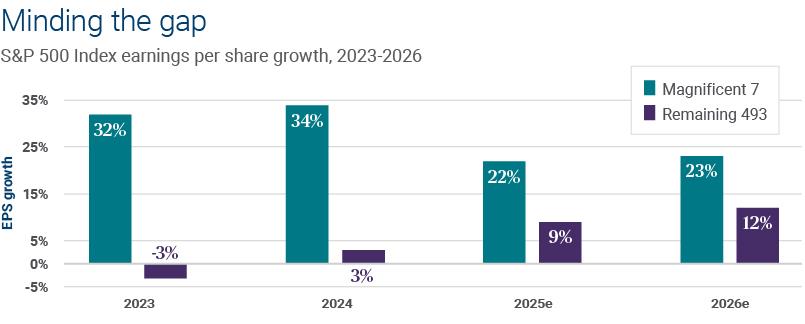
Sources: FactSet, Bloomberg as of Dec. 31, 2025. Chart shows year-over-year earnings per share (EPS) growth for the Magnificent 7 (NVDA, AAPL, GOOGL, MSFT, AMZN, META, TSLA) and remaining 493 stocks in the S&P 500 Index. Figures for 2025 and 2026 are based on consensus analyst expectations. These figures are shown for illustrative purposes only and are not guaranteed.
Strategy 2: Choose companies first, not factors or sectors
Dispersion is evident across the market, including among the Mag 7. And over the next 18 to 24 months, we expect to see greater differentiation between AI “winners” and “losers.”
The first-round leaders in the AI super cycle are unlikely to repeat the exponential revenue growth, margin expansion and share price appreciation that they’ve enjoyed since 2023. Yet the AI theme is well-poised to remain a market-driving force.
Overall, we’re looking in new places to capitalize on AI progress and we see opportunities emerging across sectors as use cases for the technology begin to materialize.
Investing perspective: AI is still a force not to be ignored. We believe it is important to choose mega-cap stocks wisely while sniffing out other high-potential candidates, not on factor or sector preferences but on their individual ability to grow earnings beyond consensus expectations. We’re looking for companies among the “other 493” that are emerging from a 2023-2024 earnings recession.
Strategy 3: Diversify within AI
Many investors believe firmly in AI as an investment opportunity but may be worried about crowded positioning or the untold return on big capital expenditure spending — or they may simply be seeking unique expressions of the theme.
However, a growing number of companies across industries are using AI to gain a competitive advantage. To that end, our team ran a quantitative screen to identify such companies and then analyzed whether AI is having a measurable impact on company margins and revenues. As the chart below shows, our evaluation found that the list of companies is small but growing, making it a potentially good time to pick up on a budding trend.
Investing perspective: Rather than focusing solely on headline AI leaders, we see opportunity in companies that are quietly integrating AI into their operations to drive efficiency, improve margins or unlock new revenue streams. These businesses may offer a differentiated way to participate in the AI theme while maintaining diversification within a portfolio.
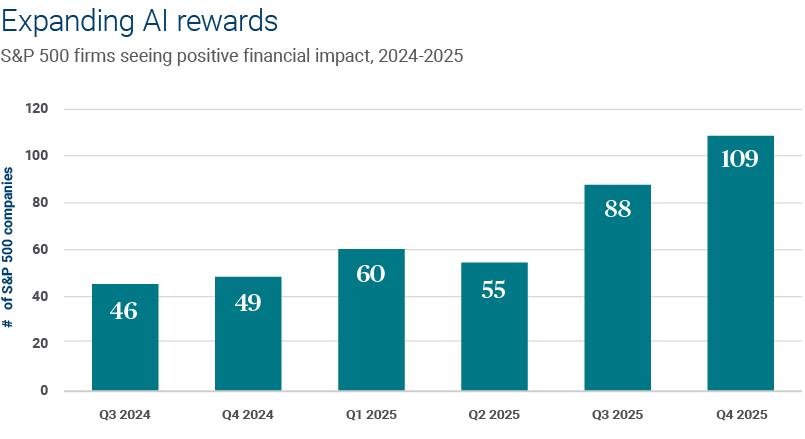
Source: BlackRock Fundamental Equities Quantitative Research, February 2026. Chart shows the number S&P 500 Index constituents using AI with tangible financial impact, such as improving margins, based on proprietary analysis of company transcripts in each quarter.
Put these insights into action
As the market landscape changes, your Ameriprise financial advisor is here to help you adjust your investment strategy accordingly. If you’d like to assess the strategies outlined in this article for your investment portfolio, connect with them today.