What’s driving investment performance in emerging markets these days looks a little different from in the past.
For years, the emerging market narrative has been dominated by China’s growth story, India’s rising middle class, and the abundance of commodities like oil and metals. But that view no longer reflects what’s really driving returns today.
Under the surface, an examination of the MSCI Emerging Markets (EM) Index — a widely used benchmark that tracks the performance of large and mid-cap stocks in developing economies — reveals that technology companies are becoming a more powerful force for growth. Overall, emerging markets are becoming more concentrated in Taiwanese and South Korean tech leaders, driven by long-term trends like AI investment and demand for computing power.
Here’s what you need to know about this shift, and how it could impact your portfolio.
China loses ground to Taiwan
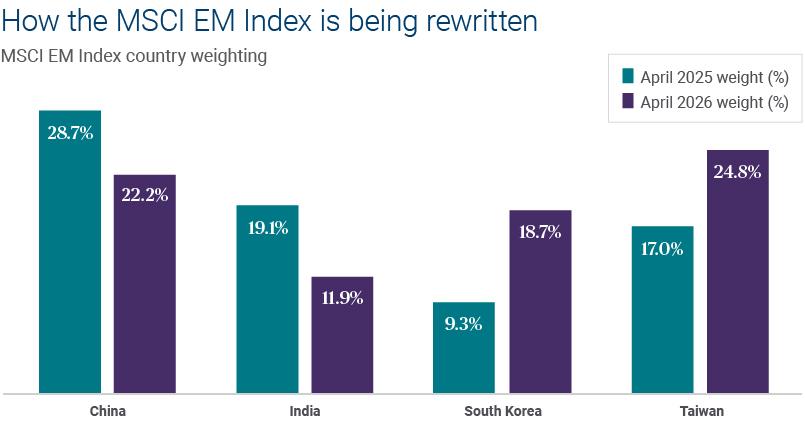
China remains the largest country in the MSCI EM Index, but its influence has declined noticeably over the past year. Investors have been moving money away from broad China exposure and toward markets more directly tied to AI and chip manufacturing, particularly in Taiwan. For example, from April 2025 to April 2026, China’s index weight fell by more than 600 basis points as international investors reallocated capital to AI-levered Taiwanese equities, which account for nearly a quarter of the index as of the end of April 2026.
Source: FactSet / AEIS
India’s growth outlook remains, but its index role has shifted
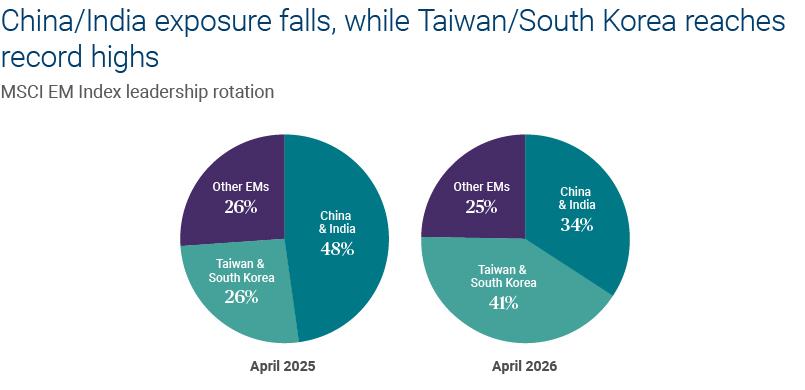
India now makes up a smaller share of the MSCI EM Index, trailing behind Taiwan and South Korea. In our view, this slip in ranking is indicative of short-term market dynamics, not necessarily a decline in India’s long-term growth potential.
For example, India’s stock market is more focused on financial services and consumer businesses, which haven’t benefited as much from the recent surge in AI-related investment. As a result, India has played a smaller role in broad emerging market portfolios recently, even though its long-term outlook remains positive.
Overall, emerging market growth today is being driven more by advanced technology than by consumer spending or expectations of a rapid China rebound.
Source: FactSet / AEIS
South Korea steps into the spotlight
South Korea has been one of the biggest beneficiaries of the AI capital investment cycles. Its share of the MSCI EM Index has more than doubled, largely due to strong performance from technology companies that support AI computing and memory chips.
As these companies increased in value, their weighting in the index naturally grew. This means that emerging market exposure today is increasingly tied to South Korean and Taiwanese technology leaders, rather than commodity-focused economies and energy exporters.
Emerging markets are becoming more concentrated
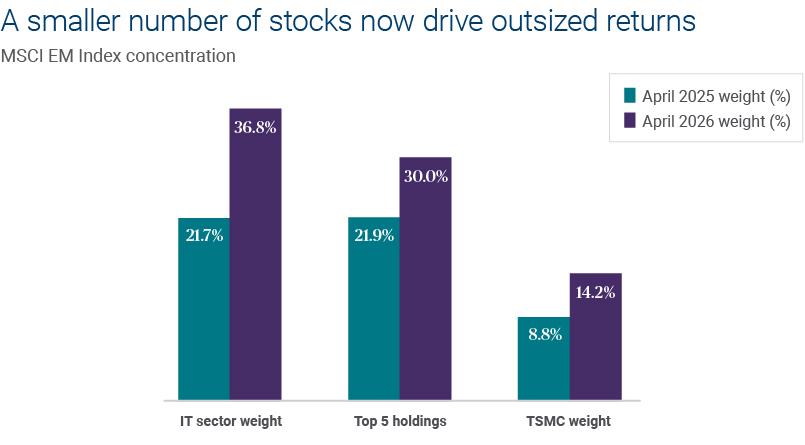
Taken together, concentration within the MSCI EM Index has edged higher. Its performance is now driven by fewer countries and fewer companies than in the past. Technology stocks account for more than one-third of the index — the highest ever — and a relatively small group of large companies now plays an outsized role in overall growth. Case in point: Taiwan Semiconductor Manufacturing Co. accounts for nearly one-seventh of the total index, as the chart below shows.
Overall, the index is now driven more by the ups and downs of semiconductor companies than by the broad mix of emerging market growth stories that once defined it.
Sources: FactSet / AEIS
TSMC: Taiwan Semiconductor Manufacturing Co.
This higher level of concentration can work in investors’ favor when technology markets are strong, but it can also lead to bigger swings when conditions change. In short, the opportunities for returns may be greater for investors, but so are the risks.
What this means for investors
As a result of these evolving dynamics, investors may want to adjust how they think about emerging market exposure in their portfolios:
- Reexamine what “emerging markets” represents in your portfolio: The emerging market narrative is now shaped less by individual country stories and more by technology leadership, particularly AI and semiconductor companies in Taiwan and South Korea. Looking beyond headline country labels to understand what’s driving returns can help ensure your exposure still aligns with your goals and risk comfort.
- Balance opportunity with risk: Greater concentration in technology can boost returns when markets are strong, but it can also increase volatility. Diversification (across asset classes, industries and countries) remains important.
- Keep an eye on the U.S. dollar and energy prices: While emerging markets are less tied to commodities than they once were, they are still influenced by global factors like the U.S. dollar and energy prices. A stronger dollar can weigh on emerging market returns, and rising energy costs can affect countries that rely on imported oil and gas.
- Be thoughtful about timing: Short-term market pullbacks driven by currency moves or energy prices may create opportunities for long-term investors, especially when fundamentals remain intact.
Bottom line
Emerging markets today look very different than they did just a few years ago. Much like the U.S. market, technology and AI-related companies are now playing a more central role.
If you’d like to better understand your investment portfolio’s exposure to emerging markets, connect with your Ameriprise financial advisor. They can help you consider the role that international investing can play in your portfolio, given your risk tolerance, time horizon and financial goals.